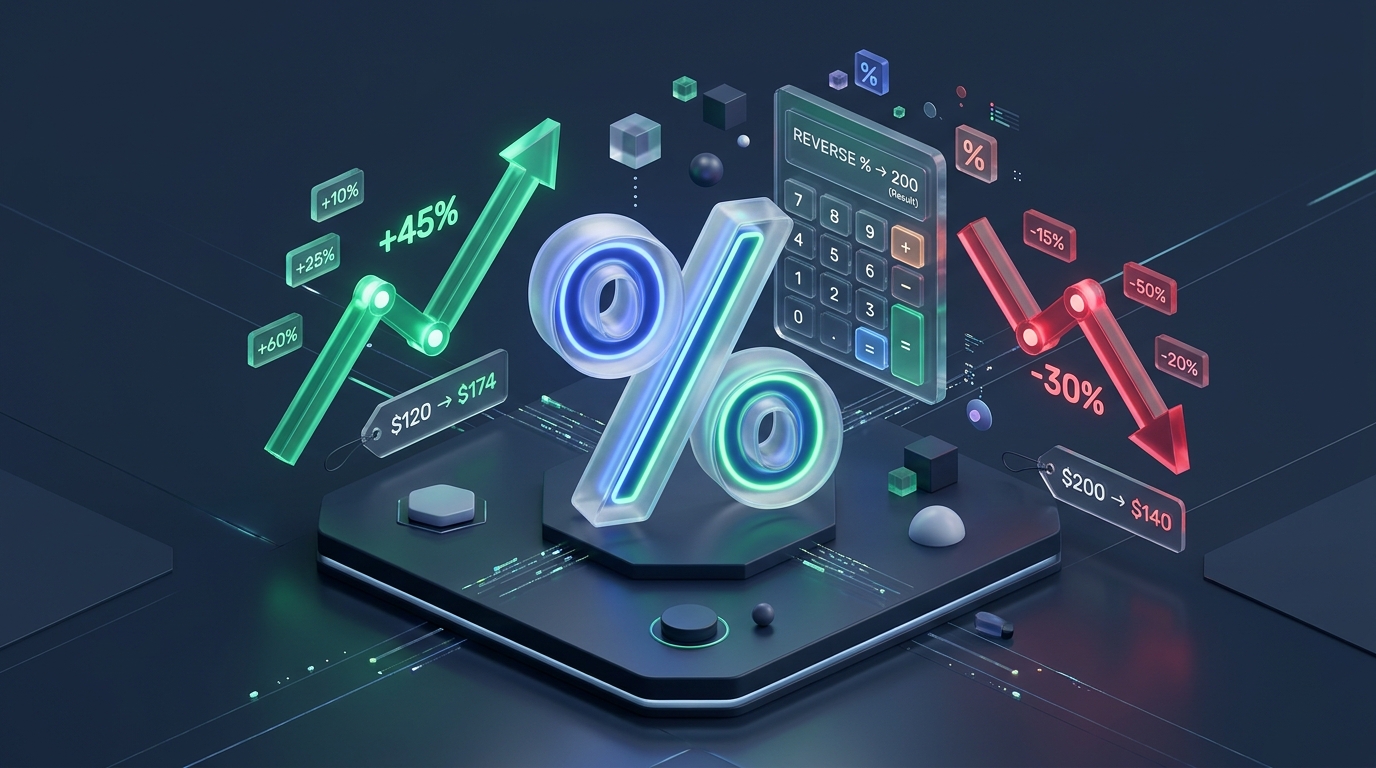
Percent change calculations are among the most frequently utilized mathematical concepts in modern daily life, from tracking investment portfolio growth to evaluating inflation rates and retail clearances. Understanding the distinction between forward percentage markdowns and reverse base price algebra eliminates costly commercial miscalculations.
The Governing Percentage Change Formula and Rules
Percentage change measures the relative difference between an initial starting baseline value and a subsequent final value. Whether tracking population growth, product price increases, or weight fluctuations, the governing mathematical formula remains identical:
Percentage Change = ((Final Value - Initial Value) / Initial Value) × 100%
The algebraic sign of the result indicates the direction of change:
- Positive Result (+): Represents a percentage increase or gain above the starting baseline.
- Negative Result (-): Represents a percentage decrease, markdown, or reduction below the baseline.
- Zero (0%): Represents static equivalence with zero change.
How to Calculate Percent Increase and Decrease in Three Steps
Solving percentage change problems reliably requires three straightforward mathematical steps:
- Step 1 Find the Absolute Difference: Subtract the initial starting value from the final value: ΔV = V₂ - V₁.
- Step 2 Divide by the Starting Baseline: Divide the difference ΔV by the original baseline V₁. Always divide by the initial number, never the final number.
- Step 3 Multiply by 100: Multiply the resulting decimal fraction by 100 to convert into a standard percentage.
Worked Example 1 Price Increase:
A textbook price rises from $60 (initial) to $75 (final).
Difference: 75 - 60 = $15.
Relative ratio: 15 / 60 = 0.25.
Percentage change: 0.25 × 100% = +25% increase.
Worked Example 2 Value Markdown:
A laptop price drops from $1,200 (initial) to $900 (final).
Difference: 900 - 1,200 = -$300.
Relative ratio: -300 / 1,200 = -0.25.
Percentage change: -0.25 × 100% = -25% decrease.
How to Calculate Reverse Percentages and Original Prices
Reverse percentage problems are among the most misunderstood concepts in practical arithmetic. In a reverse percentage scenario, you are given the final price after a tax or discount has been applied, and you must determine the original starting price before the change occurred.
The single most dangerous misconception is simply taking the percentage off the final price. For example, if a jacket on sale for $80 was discounted by 20%, subtracting 20% of $80 ($16) to claim the original price was $96 is mathematically false. The discount was taken on the larger original amount, not the discounted final amount.
The Governing Reverse Percentage Formula:
Original Price = Final Price / (1 ± (Percentage Rate / 100))
Use (1 - Rate) for discounts and markdowns. Use (1 + Rate) for sales taxes and markups.
Worked Real World Reverse Percentage Problem
Scenario: You purchase a laboratory sensor for $230 including a 15% state and municipal sales tax. What was the pre-tax wholesale price of the sensor?
Step 1 Formulate the multiplier:
Since tax represents an increase over baseline, the multiplier is 1 + (15 / 100) = 1 + 0.15 = 1.15.
Step 2 Set up the algebraic equation:
Original Price × 1.15 = $230.
Step 3 Divide final price by multiplier:
Original Price = 230 / 1.15 = $200.00.
Verification:
15% of $200 = 0.15 × 200 = $30. Added to baseline: $200 + $30 = $230, which exactly matches the total checkout receipt.
Key Takeaways for Students and Professionals
Keep these fundamental rules in mind whenever evaluating commercial or academic percentages:
- Baseline Priority: Always divide by where you started from. The starting point dictates the denominator.
- Symmetry Trap: A 50% increase followed by a 50% decrease does not return you to your starting value. If $100 increases by 50%, it becomes $150. A 50% decrease on $150 drops the value to $75.
- Instant Verification: Use CalcSolver Percentage Tools to verify complex financial ratios, check step by step variance tables, and print academic proofs with complete client side privacy.